












Each and every one of our teachers had a teacher, someone who, before they knew it, showed them exactly who they wanted to become. Before they stood at the front of our classrooms, mentoring us, they were sitting in one, watching someone else do it first.
It’s easy to see our teachers as they are now: confident, knowledgeable, fully formed. But it’s more fun to ask, “what made them that way?”.
I sat down with three members of our faculty to find out. Their answers range from a mom who turned every road trip into an exciting learning lesson to an inspiring English teacher to a professor who became the first female president of an Ivy League.
What united all three stories was one simple statement: the people who shaped us rarely know how deeply they’ve done so.
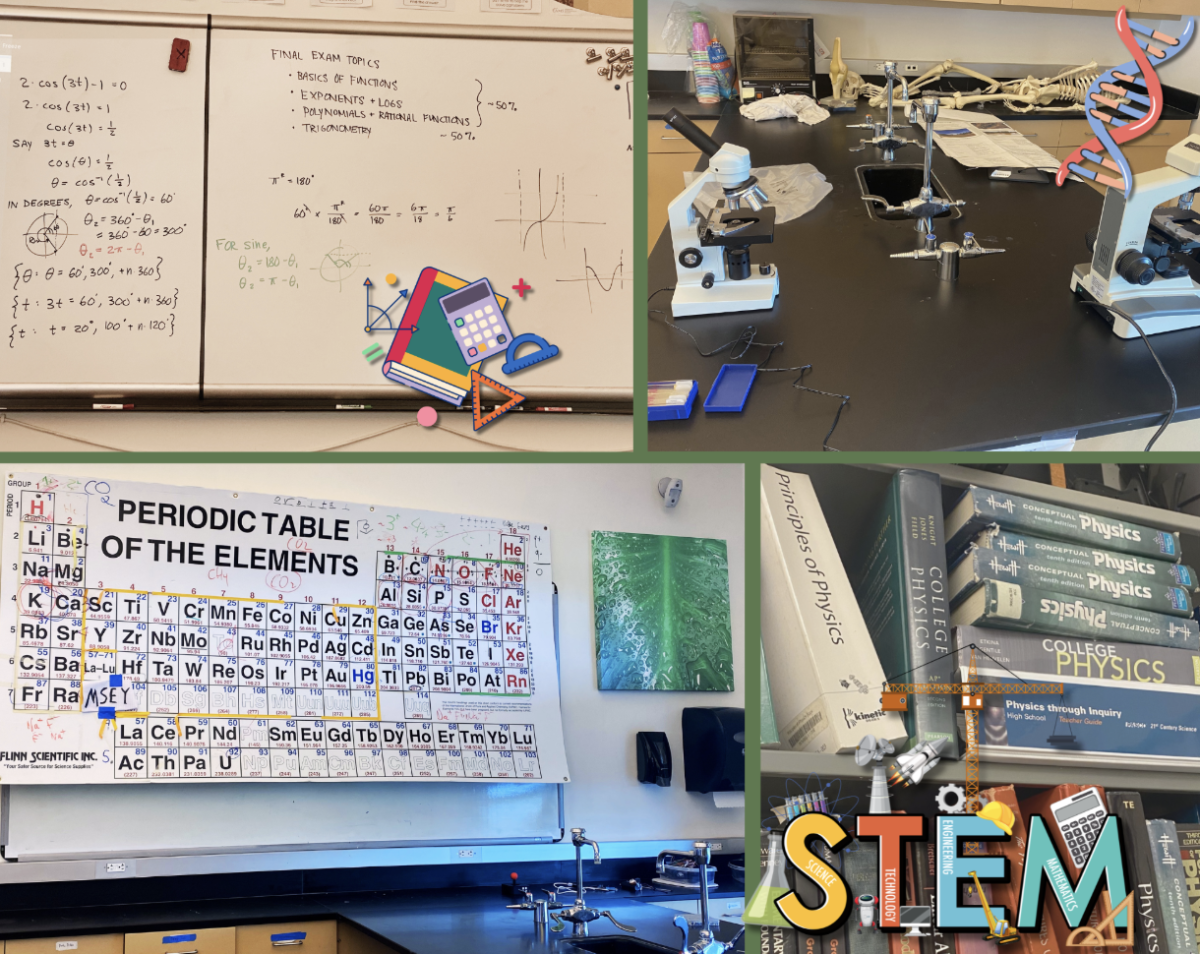
STEM Teacher Becca Gordon: The Math Teacher Who Almost Wasn’t
If you ask Becca Gordon’s parents, her career path was never really in doubt.
“I think they always knew I would end up back in math,” she remembered. However, she also acknowledged that the road there was full of fulfilling detours.
Gordon spent a significant time in high school exploring theater, reinventing herself more than once before finding her way back to numbers. Her parents, both mathematicians themselves, were supportive through every circuitous route.
As she recalled, their messages were always encouraging, “‘You’re a theatre person,’ ‘you’re an English person,’” but they came with a gentle reminder: “but you know, don’t forget Math.”
That parental influence truly does run deep. Gordon’s mother specialized in high-level mathematics, her father in combinatorics. Even today, they write papers and give talks together despite their different areas of expertise.
Gordon credited their warmth and playfulness to her own teaching style, saying, “my parents are very, very silly.”
She and her family still talk math over dinner, using those conversations to work through lesson plans. She credited the winding nature of her own journey as something that she holds up as a lesson from her parents in and of itself. “You can always reinvent yourself,” Becca said.
“The road to becoming that person is what matters more: the journey is better than the destination.”
Humanities Teacher David Hyde: Margin Notes And A Mother’s Enthusiasm
Hyde named two people. The first, a replacement English teacher named Mr. Cauldron, came to him during the second semester of senior year. Cauldron arrived with a pretty fearsome reputation.
“He had a very strong reputation for being the hardest teacher,” Hyde recalled. “I was like ‘oh no!’”
He eventually came to realize that he had never experienced a class quite like this before, with a teacher who pushed students to think deeply and critically and who took their ideas seriously.
“You could call it fate, the universe, whatever,” Hyde said. “But I feel so fortunate that whatever happened, happened. I’m glad I got to spend that single semester with that single teacher that I look back on fondly.”
The class Mr. Cauldron taught kept journals. One day, writing about the philosophical uncertainty of senior year, Hyde scribbled out one of his thoughts in the margins of his notebook. Mr. Cauldron read it and wrote back just briefly in the margins.
The note said, more or less: “you’re a real intellectual.”
“I’m sure he didn’t even think twice about it,” Hyde said, “But it stuck with me. Because at that point in my life, I had done fine in school, but I didn’t really think I stood out that much. I certainly wouldn’t have described myself as an intellectual, but in that simple little comment I was like, ‘oh maybe I do have something interesting to say, maybe my ideas are worth putting down on paper and sharing.’”
The lessons he drew shape how Hyde teaches us now. “You don’t need a lot of time with students. You don’t need to be perfect in every way as a teacher, but if you bring your authentic self to class, there’s a chance that even in that short time you might do something that really resonates with a student. I really have always felt indebted to him for what he offered me in those couple of months.”
The other person who shaped Hyde was his mother. Although she had never set foot in a classroom professionally at the time, she had already been teaching him his whole life.
“Every family trip we went on, my mom helped me realize what an opportunity it would be for us to learn to experience new cultures and see new places.”
What Hyde remembered most is his mother’s energy. He recounted a time when the family had been driving for hours in 115° desert heat with two kids who had been bickering the whole way. Regardless of the circumstances, she would light up the moment they arrived somewhere new.
“After that we would just have to keep up with her,” Hyde reminisced.
He carries the enthusiasm for life and the love of inquiry into his own classroom. His mother, now retired, is still in contact with her former fourth grade students, students who have since gone to college and built careers.
“I’ve always seen the value and reward of being that kind of teacher,” he said. “ I don’t think I’d be the teacher I am today if I didn’t have a mom who is the person that she was.”
Humanities Teacher Drew Gloger: The Most Important Person In The Room
Drew has had a series of remarkable mentors: a senator, a judge and many college professors. But when asked to name his number one, he remembers his law school professor, Elizabeth Garrett, who would become the first female president of Cornell University. When Gloger knew her, she was a star on a steep trajectory, a colleague of Barack Obama’s during his time in Chicago.
What he remembers, though, is not her fame, but her humility.
“If I sent her an email, I’d get a response quickly. And this was somebody who had a very full inbox,” Gloger recalled.
She took time to write personal notes when their co-authored article was published, she gave him a graduation gift, and once, when he and his wife ran into her at an airport, she stopped to talk for a little while.
“Little things like that,” he said, “where you have a person who really cares about your development, your education, your growth.”
As his advisor on his law review article, she pushed him hard, filling in the margins with handwritten, encouraging feedback.
“She was being tapped by the president to serve on committees and she thought my ideas were good ideas,” Gloger said. “She took them seriously, so that made me take myself seriously.”
The lesson he brings into his own teaching is deceptively simple: be timely, be present and treat everyone like they matter.
“Any time someone says ‘I’m so busy I couldn’t do it,’ I think: I knew someone who was way busier than you are and she could do it.”
Whatever student, Gloger follows a similar principle: “giving [students] knowledge and attention is really important. And celebrating [the whole student] is extremely important, I think.”
Through every timely note he returns and every student he makes time for, something of Elizabeth continues.
A route full of twists and turns, a road trip and an email answered quickly. These are small things. But to Becca, David and Drew, it became clear that real teaching has always lived in the small things a mentor can do. In the parent who makes every road trip a lesson, and the teacher who sees something in you that you can’t yet see in yourself. Standing at the front of the room is a person who was, not so long ago, sitting exactly where you are now.


Laura • Jun 3, 2026 at 10:59 am
That’s our sweater.