




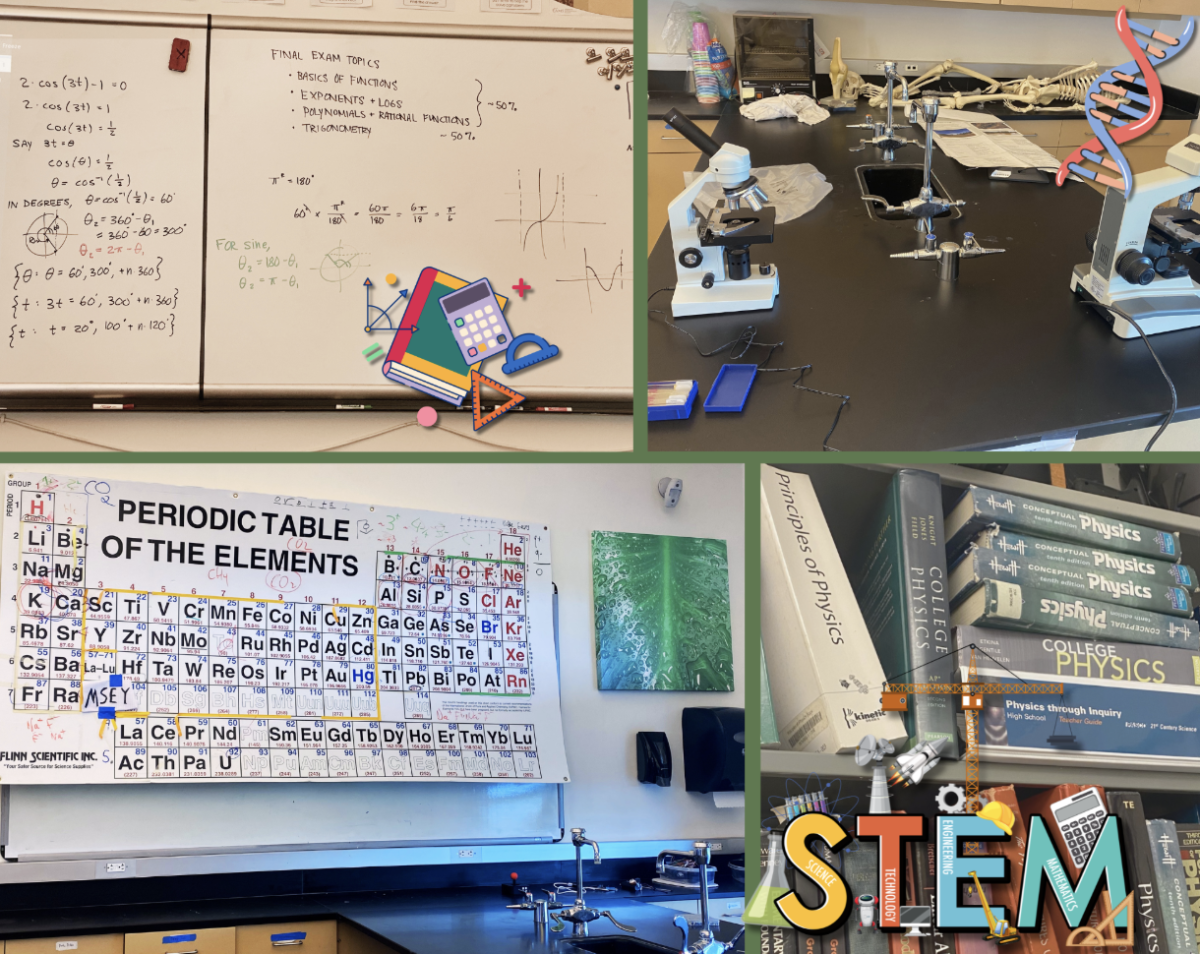






English, Math, Science, and History. These are the four core subjects in schools worldwide. Together, they form the foundation of what society deems a well-rounded education, which teaches students essential critical thinking, reading, writing and problem-solving skills for the real world.
However, I feel that core classes in the STEM curriculum at SA are not given adequate time to cover the required material students should know.
Core math classes, Algebra I and II, are exceptions in terms of their length. They are the only year-long STEM courses the school offers, meeting three times a week in 55-minute periods.
I spoke to a variety of students and teachers, both those who are into STEM and those who are not, to gauge community opinions on the length of STEM classes.
Wesley Strassburger (’28) is a sophomore with an interest in physics, biology and earth science. He shared, “Last year, in Astronomy, we simply didn’t get to cover that much. Even though it wasn’t rushed, there just wasn’t enough time to cover everything.”
Having been in the same class with him as a freshman, I agree. However, this was during the last school year’s unusual seven-Mod schedule, when Astronomy was a one-mod class. For those who did not attend SA last school year, this was merely 1.5 months to cover as much information as possible about this complex scientific field.
This year, we had a semester-based system. Though Astronomy is a semester-long elective course this year, I feel like core STEM classes are treated as semester-long electives rather than required topics students should learn, even if some don’t want to major in STEM.
“For the core classes like physics, biology, or math classes, you might need them later down the line. Those should definitely be year-long,” Strassburger added. Even though he does not like math, he noted that his algebra class feels pretty rushed.
Additionally, SA’s class scheduling system forces STEM teachers to sacrifice more advanced material necessary for a deeper understanding of the overall concept.
The Head of the STEM Department, Lisa Zavieh, said, “It’s a real challenge to curate exactly what we deliver in that smaller amount of time to still make [STEM courses] rich, meaningful, and academically rigorous.”
Math Teacher Amber Greer stated that it is impossible for STEM teachers to cover everything they want in a single semester because they have to condense material and decide what is most important to teach.
Consequently, this can lead to a more rushed learning experience for students who do not work well in faster-paced environments. The rushed timeline makes it harder for students to master something like a complex math unit in a semester, especially if they’re not mathematically inclined.
STEM Teacher Alex Kirby values diving deeper into content and allowing students to thoroughly understand concepts, which is hard for her because she is forced to rush through material. “I feel like I have to simplify things for students, and because of that, they just sort of get a simple understanding of [the topic],” Kirby said.
Some students discussed how learning limited STEM material can be a disadvantage for those who want to take STEM-related AP exams.
Levi Mehl (’27), a major STEM enthusiast, explained, “You have to go back and teach yourself [the material], especially because of the time gaps. So, let’s say you finished a semester-long class in December and you have your AP exam in May. That’s a five-month gap between taking your class and having to take a very advanced test on it.”
Though Sarika Satish (’26) is drawn more to topics and concepts on the humanities side, she acknowledged, “I feel like ultimately [semester-long classes] are a disadvantage to students because if you want to take the AP exam, you have to self-study most of the material. That can be hard if you have extracurriculars or family responsibilities.”
STEM-related AP exams aren’t important to everyone, but there is still material that people may miss out on learning, even if they don’t take APs. Many of the same principles you learn in one STEM class are required and must be remembered for future STEM courses.
Greer made an analogy to learning math and learning a foreign language. “Math needs the same continuity, just like languages. The same parts of your brain are used for both of those.”
She added, “Math and science have a lot of details, and it can take a while for you to memorize them. But if you completely forget about [what you’ve learned] over the past six months, it’ll kind of just be starting over again.”
I personally had an experience exactly as Greer described. As a freshman, I took Algebra II, but during the fall of my sophomore year, I did not take any math courses. That meant I had forgotten most of the material I had learned, so during my practice PSAT, I struggled to solve some of the problems on the math section. This pattern can be a disadvantage to the many students who choose to take the SAT. To be well-prepared, they need a strong foundation in math courses.
While conversing with others about how the test went, I heard many people say they had forgotten almost everything they had learned in their math class. These students were not taking a math course at that time.
A friend of mine also told me that she had taken her math class in the fall of freshman year and would not take another math class until the spring semester of her sophomore year. In other words, she would have an entire year’s gap before she returns to her next math class. This means that teachers have to spend lots of time reviewing instead of teaching new material from the start.
Additionally, during the first few classes of my AS Precalculus class (which I am currently taking this spring), I had to spend time reviewing subject matter I had already learned last school year, when I should have been focusing more on new topics.
“I think math in general should be year-long, no matter what the math class is,” Kirby said. “People say that math is the language of science, because we use math to understand science. And I do think math, like language, really builds on itself, and the more you practice it, the better you get. It’s incorporated into youreveryday life.”
In contrast, some students are against year-long STEM courses mainly because they believe they reduce opportunities to take unique electives.
For example, though science is Hana Spletzer (‘29)’s favorite subject, she believes a year-long STEM course would simply stretch out the material rather than going into more advanced topics. She argues that year-long STEM classes will give fewer chances for students to take more electives.
Similarly, Siena Jasper (‘28) hoped to keep space in her schedule for different electives, even though she loves both math and science. “To add more STEM classes is to take away from what we already have, [our electives], that’s already so good,” Jasper says. Though she would like more time in her science classes, like Chemistry, Jasper sees electives as helping one get a well-rounded education to complement a rigorous academic schedule.
Other students, like Kenny Hamann (’26), believe the pacing of STEM classes is just right.
“Having semester-long classes can get you used to quicker course material or a faster course speed,” Hamann explained. “I like having a fast-paced environment, even though it can be a struggle, because it prepares you for any kind of higher-level education. It can help you feel more prepared for college through that.”
I agree that faster pacing may help a lot of students to prepare for college life and occupations in general. However, I also feel like this is a disadvantage for people who have different learning styles, preferably those who need more time to understand science and math concepts.
In reality, we are high schoolers with developing brains, still trying to learn as much as possible before we move on to the real world. I think that if students push themselves to learn at a quicker pace when it makes them uncomfortable, then they won’t be able to retain that information.
Personally, I love all the electives I am taking and am very thankful that SA offers classes that many other schools might not. It gives students a new base of knowledge that is separate from the rest of their classes, allowing them to gain a new insight into something of their interest.
However, I still see the core STEM classes as a learning priority, just like English and history (Humanities in our case), in order to understand basic scientific and mathematical principles that can be applied later in life.
It’s true that compromises can be made. Our schedule could fit in both a regular year-long core STEM class and add an optional AS version of that class. For example, physics could be a year-long class, with AS Physics as a course a student could take the following year.
Math classes like precalculus (regular or AS) could meet three times a week, just like Algebra I and II. However, the extra fifteen-minute release from class should be cut because that takes away precious minutes of learning time. These classes should be kept to 70-minute classes. This should also apply to foreign language courses, especially since students already have a free period replacing their language class before lunch.
Satish shared my first idea, adding that “everyone should complete a full year of a regular course before taking the advanced version. That kind of system would be great because teachers can actually teach foundational skills the first year, and then have the AS be a full year of university-level material.”
Spletzer and Zavieh’s ideas each catered to serving a different purpose.
Spletzer suggested keeping all the STEM and elective classes a semester long. For her, students could take a core STEM class for a semester and then take the AS version of the same subject the next semester.
On the other hand, Zavieh says, “I would love to see our school have a year-long schedule for all of our classes. Electives could be semester-long, but I think all our academic core classes should be year-long.”
Overall, there are benefits and things to consider about extending STEM courses. We should still prioritize our core academic classes to maintain a well-rounded education.
I am not saying we should neglect electives. They help students step out of their comfort zones and learn about topics they might not be able to cover at other schools. I, myself, have been in so many unique elective courses at this school that I am glad to have taken.
In the end, we should acknowledge that our schedule will never be able to accommodate every individual’s wants, including mine.
However, in considering future scheduling changes, it is worth considering prioritizing core STEM classes alongside humanities and language classes in order for students to gain the critical thinking and problem-solving skills necessary to succeed in the real world.