












If you’re a student at SA, you’ve had an advisory. When first joining one, you’re told that this is a mixed-grade group that you’ll have throughout your whole high school career to support you. You’re told that your advisor is someone that you can always count on and that will check in with you if you’re ever having trouble. But if you ask what we actually do in advisory, there will be a lot of different answers. And if you bother to ask if you’ll like it, half of the school will likely say yes, but the other half would respond with a mix of nos and mehs.
To understand the current feelings and issues surrounding Advisory, I sent out a schoolwide survey asking people about their personal opinions and experiences, which received over 100 responses. All statistics I give are from this survey.
Last year I witnessed Advisory get smushed between Community Meeting and lunch which often led to, well, no Advisory at all. As STEM Teacher and Freshman Dean Amber Greer put it, “Last year with Advisory was a disaster.”
Even though the schedule for Advisory has improved from last year, there are still some problems that should be fixed. We still have the occasional Senior Mentor gatherings that cause half of our advisory members to be absent, and opinions on advisory continue to vary throughout the SA community.
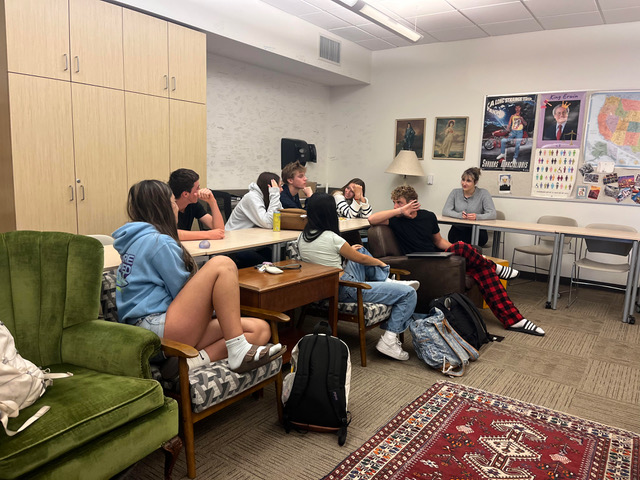
For me, Advisory wasn’t something I ever dreaded, but it wasn’t something I looked forward to either. In my experience, Advisory was just a time where a group of students sat in a room and awkwardly tried to fill the silence for the fifteen minutes that we were required to be there. And for a fourth of the SA community, the same was true. Of course, if there’s anything I’ve learned from doing the research for this article, it’s that everybody’s Advisory is different.
Some people really love their Advisories, while others don’t. Although there are a lot of components that play into the overall environment that an Advisory has, I’ve come to realize that the deciding factor in a successful Advisory is the advisor.
Lorelei Taylor (‘27) is “always happy to be” in Advisory. During a typical Advisory, “Kerry will ask a random question, and because it’s so funny everyone will respond truthfully.” For Taylor, Advisory is a space that she loves because Kerry always encourages them to “talk about random funny things.”
While there are other components like snack systems, upperclassmen behavior and the students’ willingness to participate, an advisor can have the power to break down the barriers between students and create an environment where everyone feels comfortable and excited to be there. After all, it’s up to the advisor to decide whether to follow the agenda and what to do if they don’t.
The Agenda
Sometimes, advisors are given an agenda to follow during Advisory. What’s bad about this is that sometimes the agenda, as Greer stated, is “not what we need to be doing,” and advisees might not want to participate.
On the other hand, there can also be a lack of activity where the room settles into an uncomfortable, awkward silence. In Lily Kimbel’s (‘28) Advisory, “We’ll try and have a discussion, but no one ever says that much and it just feels awkward.”
While flexibility is appreciated by some, structure is also needed. As Greer explained, “Teachers want guidance about what needs to be done in advisory, but we also want it to be meaningful and good.”
Snacks
Snacks are key to having a successful advisory. It’s something that everyone can agree on enjoying. Buying snacks, though, is the responsibility of each individual Advisory, and this can often lead to some advisories not buying any or to discomfort and pressure surrounding the purchasing of snacks, since not everyone is able to consistently spend extra money on them.
The Purpose
The main issue with Advisory is that we don’t know the purpose of it. After asking the SA community, answers ranged from “to have a space where you can share ideas, ask questions and seek help,” to one of my personal favorites, “to eat food.” But a lot of responses also ended in question marks and seemed unsure.
To Cooper Meyer (‘28), “It’s an environment that has very little purpose.” Meyer hasn’t found “anything valuable” in Advisory throughout his last two years at SA. The truth is, we’ve never been taught what Advisory is supposed to be, and sometimes we forget what it can be used for.
I believe advisory should be a place that we can always rely on for support, but that we can also look forward to. We should be able to have deep, meaningful conversations and also do fun projects that we will actually enjoy doing.
While 84% of the SA community who responded to the survey said we should have Advisory, only 53% said they actually enjoy it. Claire Huang (‘27) commented: “While I don’t necessarily look forward to it, I’m not unhappy when I’m there.”
Maybe what our community is trying to say is that there might be a value in Advisory, we just haven’t fully found it yet.
The Solution
In order for Advisory to be successful, I think everyone should contribute to the solution. I propose that a committee of admin, teachers and students be formed not only to manage the Advisory, but also to protect it and reinstate it as a priority for the school. The committee would have representatives from different grades and departments.
This group would plan activities and discussions for Advisory. They would also work with the school to decide how long Advisory should be, what time of the day, and ensure that Advisory gets a budget. This budget would be used to pay for snacks, materials for community-building activities and guest speakers.
This solution would address many issues the SA community has with Advisory, but what sets it apart is that the committee running it would include the voices of those who experience Advisory weekly. They would be there for every icebreaker, discussion and workshop.
Another equally important part of the solution requires each one of us to do our part. While we try to adjust advisory to fit the community’s ideal situation, it’s important that each advisor and student walk into Advisory with an open mind. Even if it sometimes feels, as someone described, like “dread,” getting something meaningful from Advisory also means showing up with focus, energy and effort during those 15 minutes each week.
In 2015, a similar article was published about Advisory in The Paw Print with one poll question: Should we have Advisory? Now, 11 years later, I asked our community the same question, and the responses were eerily similar:

Sonoma Academy has gone through a lot of changes, but we as a community still feel that we need advisory. While it might take a lot of work and commitment, Advisory is something our community values and therefore something we must fight to make sure is meaningful for everyone involved; it just needs some advising of its own.