







One of Sonoma Academy’s greatest achievements is its athletics. However, we have several athletes who compete outside of our school’s various teams and clubs. A lot of their recognition starts and stops at Athlete of the Week and the occasional shoutout in the Coyote Courier. I’ve decided to interview some of these athletes about their sports and watch them compete from an outsider’s point of view, before reflecting on how outside-of-school athletics are represented at SA.
First up is Charlotte Peng (‘28), a fencer and sophomore at Sonoma Academy. Peng, previously covered in this Athlete of the Week issue, began fencing in the second grade. She stuck with this unique sport because she “really likes self-defense sports. Like, watching in movies when people are sword-fighting or doing martial arts…I just think that’s super cool.”
In 2021, Peng moved from a fencing club in Santa Rosa to one in San Francisco in order to train more extensively for competitions; most people in the Santa Rosa club only fenced for fun in their free time. Now, she’s been all over the world, fencing from France to Poland to Costa Rica. She ultimately aspires to compete for the Taiwanese National team.
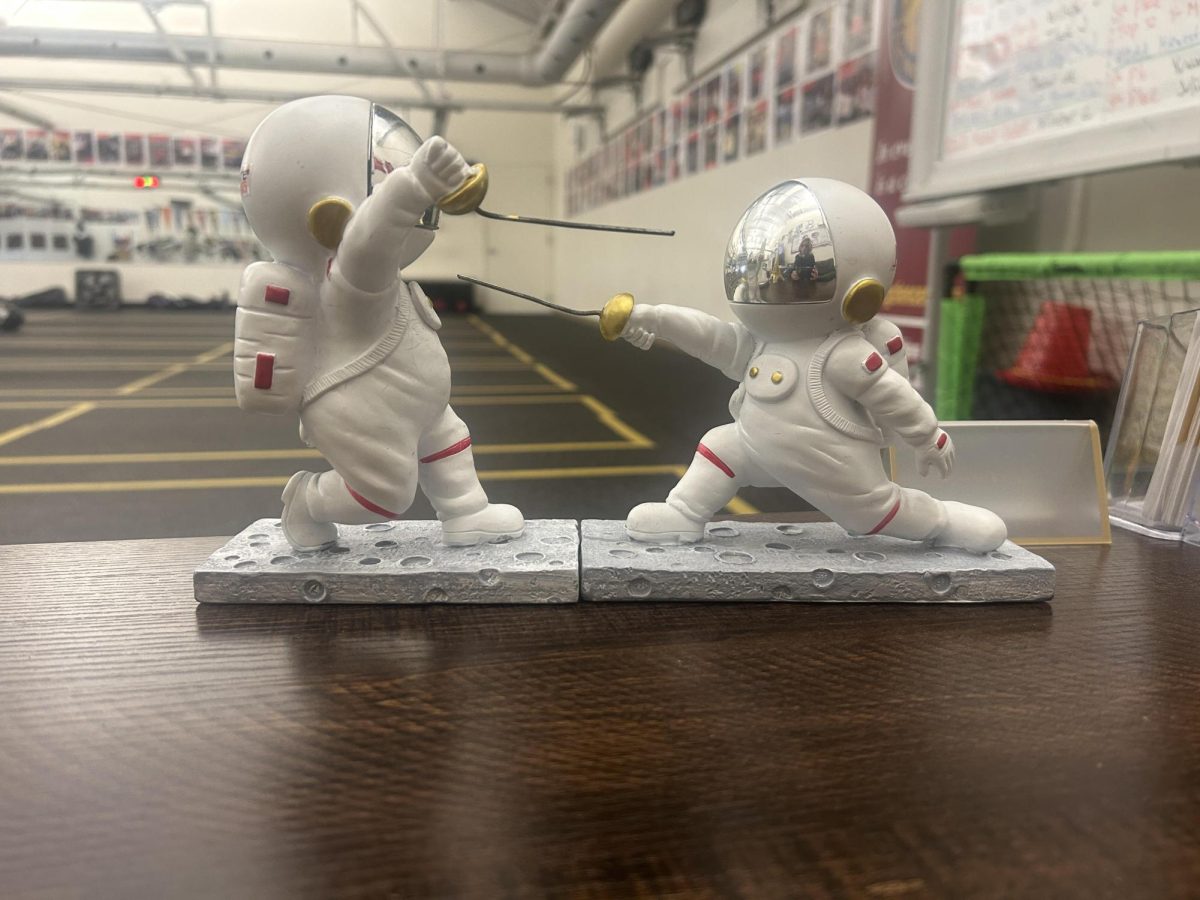
I had to know more, which is how I ended up in San Francisco at the Golden State Fencing Academy. The Academy is somewhat tucked away on the top floor of a building taken up by a gym. When we first walked in, high-school-aged people were setting up for a session, and a session of very young children was wrapping up. After a few minutes of standing, the coach came over and shook my hand before I took a seat in the corner and began observing. From what I had been told, this was a rather small practice due to a tournament and AP testing, so there were only five people and one coach, compared to the usual about twenty and four coaches. Another small child was being taught while the other five warmed up, which consisted of warm-up laps and some sort of drills.
The main part of the practice was the sparring. Each round was played to fifteen points, with one hit equalling one point. It was very entertaining to watch people spar and see how technical it really is. After the person officiating would say “FENCE!” there would be a bit of standing around until someone would attack first. All around me, I could see banners and medals from all levels of competition, even the Olympics. Clearly, this was a very well-decorated club. But even among all of that, it still felt like a friendly environment. It was just a group of people doing the sport they loved.
Next, I talked to Rio Brown (‘26), who does rodeo. Rodeo is a sport much like, say, track and field, where there are multiple different events within the one sport and multiple different skillsets. Some examples of rodeo events are barrel racing, which is racing your horse around steel drums in a clover formation; pole bending, where you have to maneuver around 6 poles; and breakaway, where you chase a calf and try to lasso it. When asked what her favorite events were, she said, “I really like breakaway and holes.”
Brown started riding when she was little. She did jumping, but didn’t really like it that much, so she stopped. When she was a little older, her family moved up to the Reno-Truckee area, and that’s where she got into rodeo.
“I was working at a lesson barn, and I was teaching lessons and doing summer camps and pony rides. And then I ended up buying a horse.” And after that, starting in freshman year, she began doing rodeo.
When she moved back to this area in her sophomore year, she continued to do rodeo. In fact, she was the State Rodeo Queen, which, according to her, “It’s more a pageant, but you do have to complete a horsemanship thing on your horse and then you do an interview, a speech and a written test.”
There is very little to no rodeo in May, especially locally. So the next best option was to watch as many rodeo videos as I could, and honestly, I wish I could go to the real thing. The environment seemed somewhat similar to a county fair and looked rather welcoming. The main events that people seemed the most excited for were bull riding and broncing. These are two similar events with the goal of staying on the back of an animal, usually a horse or bull. Broncing is interesting, however, due to the fact that you have to stay on for 8 seconds and then you have to dismount by being caught by another dude on a horse. There are also versions of these for kids, like muttonbusting, where you try to stay on a sheep.
Even though I couldn’t see them in person, it was still interesting to see those sports being performed. The way that the rider could have the horse make the tight turns was enchanting. In one Nebraska rodeo, there was horse and carriage racing with about six horses to a carriage. Now, when I say carriage, these things weren’t super fancy, but still not at all what anyone typically imagines when someone says “rodeo events.” Additionally, there are also very often 4H animal auctions. These can be very beneficial to the kids, as most of the money goes to them and can be put towards things like college funds.
And last but certainly not least is Casey Pasdach (‘27), a rower for CLUB. She first got into the sport about four years ago through a friend. Pasdach said that “the competitive aspect of it made me just want to keep coming back.” She races primarily in boats by herself or with one other person; however, in the past, she raced in boats of four and expressed interest in doing it next year.
She also mentioned how friendly the people tend to be, saying, “Everyone you’ll meet at races is always eager to talk at the start line and just hang out and say hi.” She also talked about the positive environment within her club, noting, “Our club believes that there’s a seat in the boat for everyone,” which is in contrast to other clubs, which can be more selective.
Pasdach also explained that different clubs compete more or less often, with hers competing about 8 or 9 times per year, while others will go for almost every weekend a year.
Now, unfortunately, watching rowing practice is not a valid excuse to skip track, so I needed backup. In comes this story’s knight in shining armour: Jakob Monterrey Seitchik (‘27). He made the journey out to the Petaluma River to observe these very talented rowers. About 13 different schools attended the practice, from SA to Credo to Tech, and many more. However, due to Coyote Block and the thirty-minute commute, SA rowers are not always able to make the four o’clock start time.
Now, from there, it’s a pretty simple setup of a 15-minute warm-up on the rowing machine, get in the boat, and just start rowing. They share the property with the Van Bebbet Steel company and store their supplies in a shed up from the riverbank. They go out for ten to twelve kilometers usually, but that day they were mile repeats at certain tempos measured in strokes per minute. Then they would cool down with pulldowns to help with core strength. Which, as you can imagine, is very vital for rowing.
My time with Peng, Brown, and Pasdach led me to ask a vital question: Are outside-of-school sports represented enough, and can we do better? Peng and Brown both gave pretty resounding no’s to the first question, with Peng saying, “I feel like the school mostly focuses on achievements that our own school athletes get. I don’t think they really emphasize it,” and Brown saying, “I want to know about [outside sports] because it’s super cool.”
Pasdach gave a slightly less resounding no, saying, “I think to a certain extent, yes,” but following it up with, “but for the more niche sports, only like one or two people do it at the school, I definitely don’t think they’re recognized.” Outside of Athlete of the Week or if they are one of your friends, you will probably hear next to nothing about club athletes.
So what can be done? Ultimately, there will always be less recognition for these athletes as it’s harder for the school to know and communicate about their accomplishments. However, individually, we can still spread the word and uplift these athletes either through word of mouth or nominating them for Athlete of the Week. You could even encourage them to go to or watch their competitions just to know more. And who knows, maybe you’ll also find yourself doing fencing, crew, or rodeo. As Brown put it, “I think that it’s never too late to try something new.”