







As students, we have the opportunity to get involved at SA in numerous ways. We can make our voices heard by sharing personal experiences and thoughts at Community Meeting, joining a leadership committee like the Student Leadership Council or writing pieces for the Paw Print.
But does student voice lose its inherent value when it seeks to express opinion rather than fact, or when it’s not filtered through official channels?
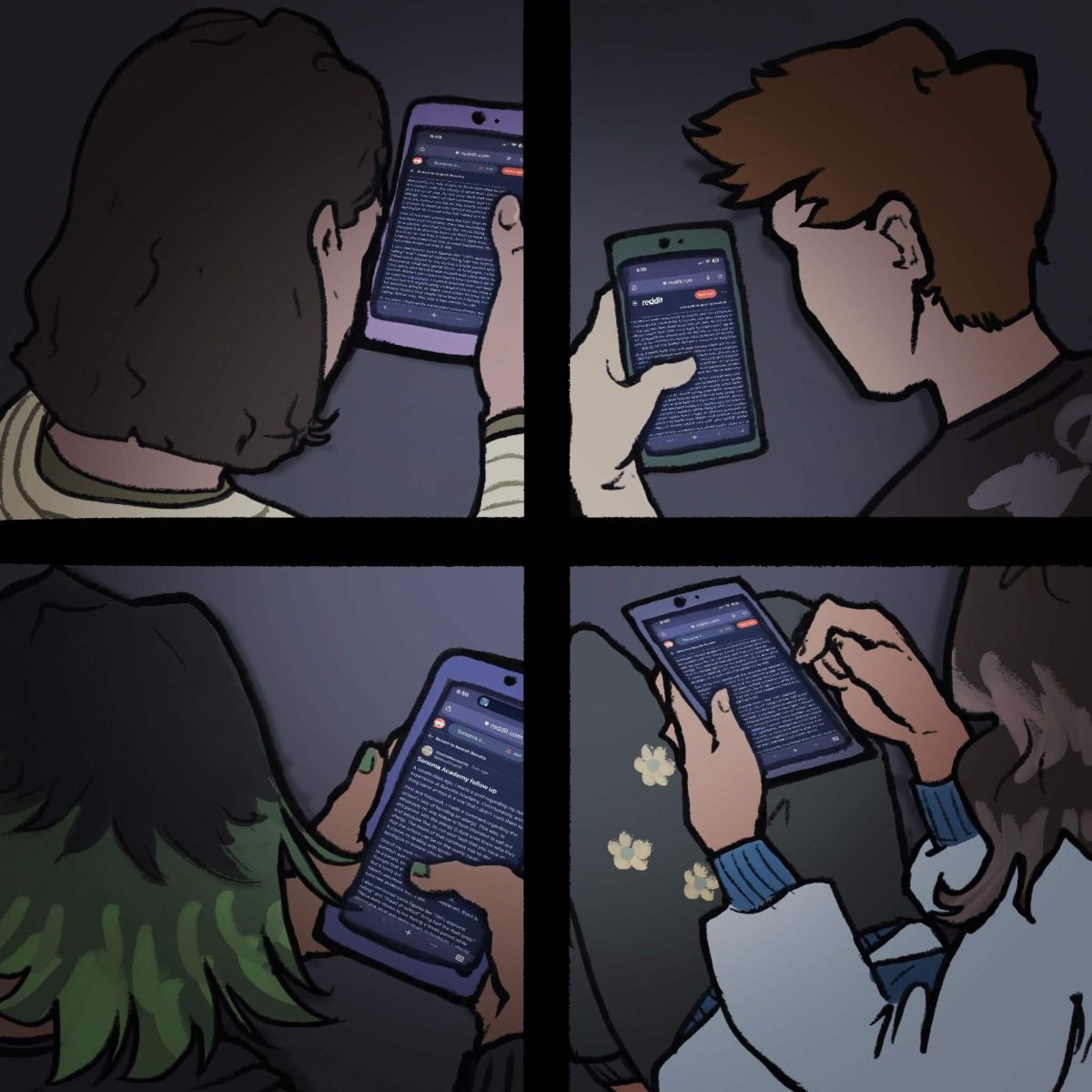
This is the exact question that was raised when Kaden Keith (‘27) wrote a critical Reddit post titled ‘Sonoma Academy has had a generational downfall’. It was initially anonymous, but he knew that he wouldn’t remain that way for long due to the fact that people recognized his username.
In the post, Keith spoke at length about perceived issues within administration and the school as a whole. Unfortunately, the post has since been deleted, but he was able to briefly outline his main concerns in an interview.
One of these things was the departure of humanities teacher Brandon Spars. Keith gave people outside of the school community a quick rundown of what was going on, repeating a rumor that has been circulating around school for months: that a student videoed Brandon and showed the tape to his parents, and they reported him to the school. He shared how he thinks admin has been keeping everything to do with Spars under the table and not being transparent with students about what actually happened.
He also wrote about the infamous ‘mod’ schedule from last year, and cited the mod schedule as the reason the previous Head of School, Tucker Foehl, got fired. He voiced grievances about the current Head of School, Percy Abram, and his 26% approval rating on Glassdoor, a review site for workplaces, from his previous place of employment.
At the end, Keith spoke about his fears that SA is becoming a much different place than it was when he first joined due to changes in administration and a perceived general lack of regard for student opinion.
“There was kind of a history of generational mismanagement,” Keith said in an interview. “And it’s becoming a much bigger issue.”
According to him, the post was driven largely by a lack of clear communication from the administration.
“If we had more transparency, I wouldn’t have made it,” he said. “I did try to talk to teachers about the Brandon situation, but they were like, ‘we’re not allowed to say anything’. I would have gone to my advisor to talk things through, but my advisor is Percy, and so I feel a little uncomfortable doing that.”
The post garnered attention from some members of the school community, as well as parents and members of the Board of Trustees.
Wesley Strassburger (‘28) acknowledged that the post was heavily opinion-based. “It wasn’t completely factual, but it captured a lot of what people were feeling.”
Much of what Keith said was reliant on accepted theories going around the school. These are so prevalent that they often become synonymous with the truth, even though that’s not the case.
Debbie Novograd, a member of the Board, gave a statement in an interview on the school’s stance on student expression. “I can confirm that Sonoma Academy supports students’ right to express opinions regarding the actions of the school, whether they are positive or negative.”
An anonymous alumnus of Sonoma Academy also messaged Keith privately to express their surprise and disappointment at the events, and some people in the comments shared rumors they had heard about the situation surrounding Spars.
Despite the response to the post being largely positive, Keith deleted it and created another one titled “Sonoma Academy follow-up”, where he stated that “some things [in the first post] came across in a way that I didn’t want them to.”
He retracted a few of his statements that he felt weren’t based on facts or were reliant on bad metrics, such as Abram’s approval rating, which he felt was unfair to use considering that he “couldn’t assume that our Head of School has not significantly changed [since his time at his previous school].”
In addition, this rating was accumulated due to 14 anonymous reviews on the website, so we should be careful of bias. Glassdoor reviews for a certain place of employment come from people claiming to be employees there, but that’s not verified. Keith later admitted that he didn’t check where the stats were coming from before treating them as fact in the post, and was relying on screenshots shown to him by a friend.
He also wrote, “I frequently mentioned some things, such as the reason that one of the Heads of School got fired. It unfortunately came across as a confirmed fact, which it wasn’t. While a lot of people believe this is what happened… we cannot assume that it did.”
Keith decided to retract the post after a conversation with Lorelai Trinidad Sinnes (‘27), a friend of Keith’s who contacted him due to “strong feelings” about the post.
“I recognize that a lot of what he said wasn’t truthful or the best well stated,” she said. “For example, he made a claim about a kid videoing Brandon and then a parent getting mad about it. That could be feasible, but it’s not verified.”
Other than ideological issues with people pushing inaccurate information, rumors have the potential to actually hurt people. The person who was claimed to have taken a video of Spars was spoken badly about by students for months, even when no one knew whether they actually did it or not. Although this may have not been Keith’s intention when he made the post, stating rumors as fact encourages negative repercussions. In addition, their effects can be amplified in a school as small as SA.
Trinidad Sinnes brought up a specific issue within the post, where Keith had criticized the school’s strict no-latex policy. “It reads as being very directed towards another student in our school who has a very serious latex allergy. If I had written the post, I definitely wouldn’t have mentioned that.”
Keith acknowledged his error. “I wasn’t trying to do that at all, but I can see how that could have been misunderstood, unfortunately. I was trying to say that the admin goes overboard trying to protect themselves from a lawsuit. Like banning balloons versus banning bananas because of the latex wrapping around the top are two different stories, in my opinion.”
Other than that, Trinidad Sinnes had a broader issue with how Keith represented the issues in the school community. “It’s important to be respectful and formal when trying to make a statement about these things. You should be able to give your own opinions and speculate, but you have to make it clear that those things aren’t fact when talking to those outside of a community.”
Strassburger had a slightly different opinion. “You should identify what is speculation and what stuff is known to be true, but it’s a pretty reasonable post considering what is going on.”
Trinidad Sinnes emphasized that she didn’t disagree with Keith’s points, but rather how they were expressed. “When admin speaks, they use a lot of language that contradicts what they are saying. Like, sometimes they say ‘this is all we can give out’, but they also say ‘this is all we know’ in the same sentence. It makes it seem as though there is more to the story than what they are telling us.”
“I want admin to try to be as open and clear as possible,” Strassburger agreed. “I don’t want a repeat of Percy’s PS announcement the day everything went down.”
On the day after an email officially announcing Spars’ departure was sent to the student body, Abram went up at PS to speak on the subject. He gave a statement about how admin had given people all the information they were allowed, and shed some light on issues that he wanted to resolve, such as grade inflation. Students didn’t respond well to the announcement as they felt that it lacked sincerity.
Despite their disagreements, all three students ultimately point to the same underlying issue: a lack of clear communication from the administration, which breeds the kind of speculation that infiltrated Keith’s post. Although both Trinidad Sinnes and Strassburger saw issues with Keith’s statements, both of them echoed his opinions on the matter.
When official channels feel limited or unclear, students may turn to less formal platforms to make their voices heard. But these spaces often come with fewer expectations of precision and a system that rewards people for being controversial, which raises questions about credibility.
“The comments were pretty positive on the original post, but then a lot of people were upset that I retracted some of my statements on the second one,” Keith said. “It’s interesting when I can be ranting and that’s okay, but if I’m trying to correct myself, that’s frowned upon.”
Keith’s attempt to correct himself was well-intentioned, but not everyone is so eager to admit that they made a mistake, or have people around them who want to hold them accountable for their actions. If the lack of communication at SA persists, we may see a rise in unmoderated student opinions on social media, where anonymity may embolden them to not verify if what they’re saying is true. This environment also leads to a rise in harmful rumors. While administration has encouraged students not to spread rumors, it’s difficult if students feel like they aren’t being told the whole truth.
“I do think that when you’re keeping people in the dark, it’s hard for students to not create stories and theories about what’s going on,” Trinidad Sinnes said. “When there are gaps in what we are being told, we as human beings want to fill those gaps.”
The issue is ultimately not whether student voices are valuable or not, but how they are shaped by the environment in which they exist. When communication is transparent, student expression is more likely to be grounded in fact. But as we saw with Keith’s post, when transparency breaks down, expression can become a vehicle for speculation and miscommunication.
If SA hopes to foster student voice, the responsibility isn’t solely on students to fact-check themselves. It also lies with the school as a whole to create an environment where students are given enough information and care enough to speak accurately.