

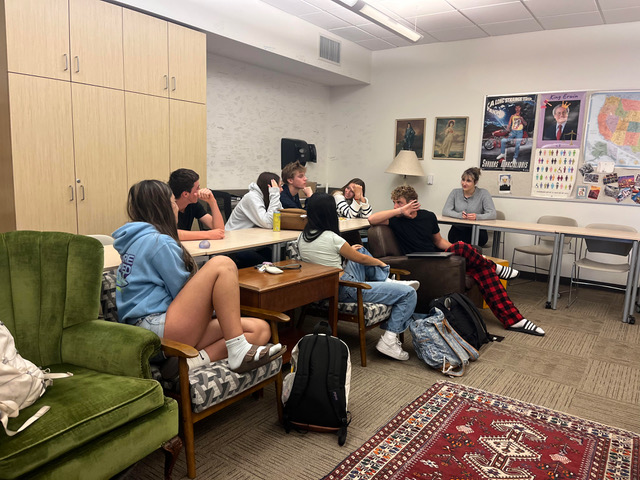






There’s a taxidermied moose in Drew Gloger’s classroom. There’s also a fire extinguisher, a First Amendment reference and a wall of names with advice from past students.
These objects serve as stage props for AS American Constitutional Law at Sonoma Academy, Gloger’s flagship class offering at our school. As Humanities Department Chair, Gloger is the closest thing SA has to a steward of the law, and he plays the role with everything he’s got.
This unique course is the first opportunity many of us have to learn about the Supreme Court and the rule of law in America. From debating contentious issues such as abortion and gene editing to writing and presenting a fully polished legal brief for our final project, his class provides many moments of deep inquiry that will stick with alums of the class for a long time.
I still remember sitting in the back of this class during my shadow day at Sonoma Academy in 2021. As I stared his majestic taxidermied moose in the eyes, the lively and engaging discussions in his Constitutional Law class really hooked me on the idea of coming here for high school in hopes to learn and think about problems in a similar way.
Gloger’s presence in our community is extremely powerful. He invites us to think more deeply about all kinds of issues, from sports dilemmas (the 2021-22 renaissance of Stephen Curry) to life mottos in Humanities III.
When you look around Gloger’s room or talk to him, his passion for the law is impossible to miss. For example, he references United States v. Schenck, with a sticker “I Love the First Amendment,” placed right next to his extinguisher. (This case’s ruling is the reason free speech can be restricted if it causes “clear and present danger.” It’s why you can’t yell “fire” in a crowded theater!)
The path that led Gloger to instill this excitement and curiosity for the law in many SA students started long before he came to our school, in a field far away from legal rhetoric.
Gloger studied at Brown University for his undergraduate degree, concentrating in Modern Culture and Media. Brown is known for its open curriculum focus on interdisciplinary study, and Gloger loved the vast amounts of “theoretical and textual analysis…which are like bread and butter skills you need in law school.” He said that this education set him up perfectly to research cultural connections between politics and art.
His excitement around politics didn’t start in a courtroom or classroom. It started at a television screen in his college dorm. “I was in my senior year of college during the Bush vs Gore election, the disputed election of 2000. That got me interested in politics.” After attending college, he went to Washington DC and worked on Capitol Hill for a few years, writing letters to constituents for Representative Jon Kyl (AZ-4).
Gloger wasn’t set on law school until he was in the capital during the attacks of September 11th, 2001. In Washington, congressional officials and their staffers had to hide in bunkers and annexes as the chaos of al-Qaeda’s terrorist attack unfolded. Congressional staffers were evacuated from their offices as smoke rose from the Pentagon across the river. Nobody knew how many planes were still in the air. For a young staffer from Brown who had come to DC to write letters about constituent concerns, the abstract machinery of American governance had suddenly become very, very concrete.
Gloger added that “it was a really impactful time for me to be working there. It introduced me to a lot of different ways that one can use a law degree. That’s what kind of spurred me to apply to law school.”
However, this interest in engaging within America’s political spaces wasn’t his only reason to study for his JD. “I went to law school, not necessarily thinking that I wanted to be a lawyer. I just wanted to go because it was intellectually stimulating. And it obviously led me to be a teacher.”
Gloger ended up at the University of Southern California’s Gould School of Law for his JD, and it couldn’t have felt more different from his undergraduate years. Studying there during Head Coach Pete Carroll’s era of football dominance, he balanced grinding through casebooks with slipping over to the Coliseum to watch USC’s powerhouse sports teams chase championships in the heat of Los Angeles.
Gloger went on to clerk for the Central District Court of California in LA, the second-busiest court in the country. In the United States, these federal clerkships are extremely coveted. “Many law students try to apply to become law clerks and not all of them get those clerkships.” He smiled, adding, “I got a lot of nos, and I got one yes. All you need is one!”
After clerking for federal judges, law clerks usually go on to work within law firms. As he worked on the federal circuit, Gloger wasn’t so sure about following this path in his future. “I had 2 kids, 2 young kids. I didn’t think I wanted to jump into the intensity of a law firm[…] to be in a cubicle for all hours of the day with a really narrow area of focus.”
“I was enjoying the intellectual rigor of clerking and this dynamic interpersonal nature of working in a judge’s chambers. That made me think, oh, you know, maybe there’s a different path for me.”
For Gloger, that path ended up being teaching. “I was inspired by my work at the court, working with young legal interns from local law schools. I was mentoring them, and acting as a teacher of sorts.” This made teaching young students interested in law seem like a truly natural progression for him, and anyone would agree that he is a truly amazing part of the Sonoma Academy community.
As Gloger’s own path wound from clerkships to classrooms, he saw the country around him change completely. Political literacy has fallen across America, as basic civic knowledge has declined drastically while polarization between parties and belief systems has risen exponentially.
This drastic drop in our understanding of the political spaces that drive our nation is exactly why courses like AS American Constitutional Law and leaders like Gloger are so important in high schools across the country. Deep dives into our legal system will provide us with the power and understanding needed to facilitate changes inside and outside of academia.
In fact, nationwide surveys by the US Chamber of Commerce Foundation show that more than 70% of American adults fail a basic civic literacy quiz. People commonly struggle with questions about the three branches of government, the number of Supreme Court justices and how laws are made, principles key to our country’s democratic rule and system of checks and balances against tyranny. Two-thirds of adults even said they took civics in high school, but only one-quarter said they were “very confident” in explaining how our system of government works.
Recently, ICE protests have been a hot-button issue across the nation. There are many students at SA interested in civic engagement (as we’ve seen in protests at home and abroad) and standing up to polarizing viewpoints that cause violence on both sides of the political spectrum. In a recent Paw Print article, Sonoma Academy’s Unexpected Struggle With Censorship, Hannah Perry (‘27) talked about the importance of seeing and advocating for both sides of political issues, even on small campuses like Sonoma Academy.
Gloger had some ideas for how we can become more civically involved as students. “Protesting is good. It’s true that in history, it’s made more of a difference than posting on your social media. That doesn’t mean it’s the only way to stay civically engaged with local and national politics.” He added, “In this age especially, we need to remember to think critically and stay well-read. Don’t assume everything you hear is true.” Gloger further noted, “there’s no blueprint for legal activism.”
Gloger’s legal stewardship reminds us that knowing the law isn’t just homework, but how we can learn to keep our leaders accountable and our democracy alive.
At a time when the political noise around us is constantly rising, being in Gloger’s classroom and talking with him stands out to me as a place where we aren’t just told what to think.
To me, it feels like a place where we’re trusted to learn how to argue, question, and interrogate our own ideas and beliefs on pertinent issues that impact us all.