












Why “refresh”?
At its 25th anniversary, Sonoma Academy found it was time to look back at our school’s branding and image. Director of Marketing & Communications Megan Malone led the change.
“I think it’s important for any company, nonprofit or school to think about whether their branding still reflects them accurately every 10 years or so or even at shorter intervals. This process allowed us to think about what needed to be changed most immediately and what are some things we might want to think about changing down the road,” Malone said.
Additionally, students noted how they’ve seen the pressure, as marketing interns, to increase the efficacy of SA’s internal marketing. Concerns have arisen from decreased yield rates within admissions. As Marketing Intern Kenny Hamann (‘26) said, the school is “struggling with recruitment, marketing to people and their communications to people.”
So, Sonoma Academy decided to contract Mission Minded, an outside marketing firm that works with many independent schools, for messaging advice.
Mission Minded’s presence as an external company enabled them to point out some blind spots our community otherwise wouldn’t notice, such as the unintentionally exclusive language at SA, like calling Sonoma Academy “SA” and assuming others will understand. Marketing Intern Tamar Knuth (‘26) noted other examples, such as using “CM” and “GAC” around visiting 8th graders on visit days with no explanation. She compared it to an extension of our “unwelcoming welcome booth,” making outsiders feel out of the exclusive club that is Sonoma Academy.
However, Malone noted that this use of an external firm was challenging: “It reminded me how unique we are.” She’s right: more than anything, Sonoma Academy is inherently different from other independent schools.
As Malone said, “We’re an amazing college preparatory, academically focused school. And we have this other component that I think is equally important in a lot of ways, which is our commitment to an inclusive community, and trying to meet every student where they are and celebrate what is unique and special about them… Even though a lot of schools talk that talk, I think we are more committed to it than a lot of independent schools.”
Also, Sonoma Academy is the only independent school in Sonoma County. Malone said, “A lot of people in our area don’t really understand what it means to have an independent school. One of the things that came through this process that was not a surprise to me, but was a surprise to [Mission Minded], was that we’re not just competing with other independent schools. We’re mostly competing with public schools.”
Another distinct aspect of Sonoma Academy made working with Mission Minded even more difficult: the use of students within the process. Initially, Mission Minded was against the idea. They had never worked with students in that capacity before.
However, Malone, who runs the Marketing Intern program, insisted, reflecting on past Sonoma Academy projects that included students, such as the revisions of the Strategic Plan in 2023: “At any time when we’re making a major shift, when you leave the students out of that conversation, you’re forgetting who we are as a school.”
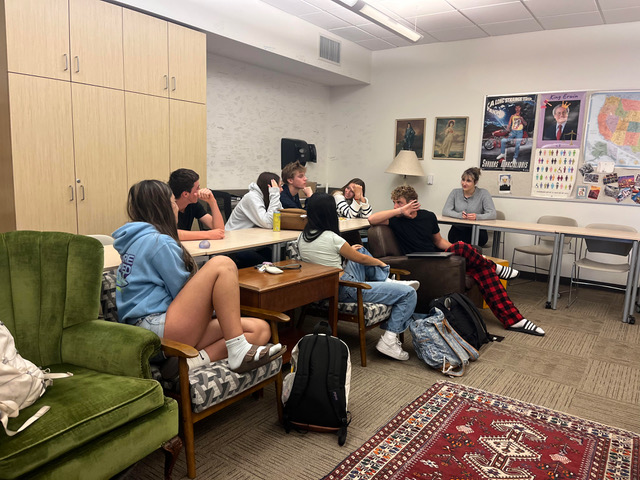
Along with Malone, the large group meetings included teachers who represented different eras and disciplines of SA, parents and alumni who had expressed an interest in being involved in decision making, along with Head of School Percy Abram, Director of Teaching and Learning Janine Extavour, Dean of Global and Experiential Programs Kelly Casteñeda, Director of External Relations Kim Eber and Director of College Counseling Rolando Crisostomo.
Malone chose these participants carefully: “We wanted to make sure that all aspects of the school experience were represented in the room.” For her, that needed to include students.
Student leadership
She invited Hamann and Knuth, along with Marketing Interns Beau Leary (‘26) and Elijah Borjon (‘26), to participate in the large meetings to help guide Mission Minded. Malone cited an interest in pulling students from a wide range of backgrounds, extracurricular and academic interests, who also had a baseline knowledge of branding and marketing.
Knuth was chosen to participate after her involvement in the Head of School search the previous year. She noted the whiplash of working with an organization not familiar with Sonoma Academy’s encouragement of student voices.
“Maybe at any other school, students are treated that way, but at this school, they’re not. Here, students are treated as if we have a voice because we do,” she said. “So that felt really off. I was like, ‘Oh, wow, we’re working with these people.’ Like, okay, this is interesting.”
Leary agreed, saying that he felt the Mission Minded representatives were “a little dismissive of ideas.” He also pointed out how supportive other Sonoma Academy community members were of the students. “There was a parent that did push back on that in a rather spectacular fashion.”
Malone noted that, “At the beginning, they were not used to having students expressing sophisticated opinions and observations.”
However, over time, the mutual hesitancy between Mission Minded and students melted away. Knuth reported, “They learned our community culture. I felt surprisingly heard. People were like, ‘oh, we wanna hear from the students’.” She was especially grateful for the support of teachers in those meetings, and noted that the students and teachers were almost always in agreement.
Knuth also noted how grateful she was to have been included in those conversations, as she felt Mission Minded was initially unaware of the students’ perspectives. Before the first meeting, Malone presented the Marketing Interns with several mock-up key messaging statements from Mission Minded.
“She wanted our opinion, and all the kids in the room were like, we do not like this one. And that was the one that [Mission Minded] had chosen that was the most popular,” Knuth recalled.
Another helpful contribution was Knuth’s experience as an SA student outside of school: “In my daily life, when I’m talking to friends outside of school or introducing myself to their friends, I don’t say where I go to high school. It’s not something I’m proud of. It’s like when I’m here – great. I’m here. I’m having a good time. But when I’m talking about it to other people my age, I don’t want to say where I go to school.”
This confession was vital for Mission Minded to understand. Malone explained, “Because we don’t have that deep culture of independent schools, there is that level of having to explain, ‘But it’s not like on Gilmore Girls!’ It’s actually not a super snobby, exclusive place.” But many people have had that experience, including teachers and parents, of having to explain before they can even get someone to listen about the school.”
Students didn’t shy away from the factors that make Sonoma Academy hard to market. Knuth explained how recent controversies unwillingly make up our school’s reputation, and how that challenged the current messaging: “Brand is your reputation. So, our brand right now has suffered through newspaper articles, through all COVID, through all these things. Now, I feel like we’re suffering through putting all of our amazing aspects, smushing it into two sentences and saying, ‘that’s us!’”
Additionally, the students repeatedly discussed the difficulty that SA’s high tuition presents. As a product of our unique standing as the only independent school in the area, the cost of the school is harder to explain, as we compete with public schools. Leary said that, within the messaging, the school must prioritize “showing that we actually recognize the fact that it is expensive and what we’re doing to justify that cost.”
However, these factors—price or reputation—are only a fraction of our image. Mission Minded and the marketing team needed to not only share what Sonoma Academy is, but find what distinguishes us. Knuth noted that our current messaging sometimes falls flat: “To people who don’t know us, they think that statement could be applied to any private school. So, what Mission Minded really wanted to do is find that one thing that can’t be applied to anything else, but that we have here.”
Leary provided insight into this process. He highlighted a key tension among the group around the purpose of these branding changes: “A lot of it was in relation to admissions, but there was also the problem of some people feel like the school we try [to] be on the inside isn’t actually how we represent ourselves.”
He said, “There was definitely some dissent of saying that the brand was fine (this was really coming from the parents), that there were definitely things that needed to be changed and it wasn’t just about highlighting our strengths. So people felt like instead of just trying to show what we do in the community, we actually needed to do more in the community.”
For example, people suggested bringing the community to Sonoma Academy by utilizing our facilities, including the PAC and the field, for outside uses. Additionally, some wanted to emphasize the need to get our students involved in impact clubs and other opportunities for community engagement.
To Leary, this would not only improve our school community, but our image: “If we can get those in the community, we can shape the perspective organically, instead of having to do full brand remodeling.”
After receiving all of the survey information, Mission Minded divided up the SA community and prospective members into different groups, based on their key values (like community engagement): the Skeptics, the Strivers, the Individualists and the Club.
They used two group meetings in September and November to present their findings of the community and gather further, specific insight into what SA is, using breakout groups to discuss values, tenets and goals.
Then, at a final small-group meeting in January, Mission Minded presented their official recommendations of the key messages the SA Marketing team should implement to attract each of the four groups. They identified key brand values (“cultivate connection,” “be yourself,” “ignite intellectual curiosity” and “explore”) and the brand personality (adventurous, expert, innovative and warm).
Malone said that the values and personality were very similar to the current branding: “I think adventurous is the one that felt the most different. We talk a lot about risk-taking. It’s the foundation of not just our Intersession and Passport Programs, but our classes; the teachers really try to push us out of our comfort zones. It’s a little different from how we would describe ourselves: ‘We’re the experts on teenagers and we know what teenagers need in order to thrive and that is risk-taking.’ So adventurous is getting to the same idea that we want students to take risks and try different things without being quite so weighed down in the philosophy.”
In essence, the main change, as Malone said, was that, “The language will be a little less wordy. We don’t want people to think we’re pretentious, right? So a little more approachable, in some ways, but also not dumbing it down and being corny. ‘Hey teens! Do you want to go to a super fire school?’ Let’s not do that.”
Mission Minded also advised a four-step approach for all brand messaging, which Hamann found very impactful: “What they taught us is that people often do these four things in the wrong order. So a lot of what Mission Minded is doing for us is giving us new things to say, but then also telling us what order to talk about SA. Usually we start with the details, like, ‘oh, it’s an amazing school, and here’s why: because we have the Passport Program.’ That’s a detail. It’s more beneficial to start with ‘here’s a problem that we see in our society, and here’s how SA fixes that or approaches that.’”
Hamann added that, by beginning with Sonoma Academy’s philosophies, beliefs, and core values, the programs we highlight, especially the Passport Program, appear less extravagant and more guided by our mission and key messages.
He also noted the excitement of seeing Mission Minded’s final recommendations at the last whole group meeting in January: his words, along with other students’, down to some exact language, made their way into the proposal.
“There’s like maybe one or two things in here that I thought of in the sessions. And I got to see it in the presentation. I was like, ‘oh, that’s something I said!’ That’s really cool.”
However, Hamann still remembered pushing past the initial animosity to make such an achievement. He argued that any student leadership position is challenging and will require fighting to have your voice heard. While he said SA is “much better than other schools” and more open to student voices, students must have some initiative.
“I had a ton of interest in this stuff, so it’s not necessarily like this showed up at my door as an opportunity. But if other students are really passionate, and I know they are, they’ll have this opportunity too.”
The “refresh,” Malone and the students agreed, was a resounding success for student leaders. They gained invaluable experience and marketing knowledge, and Mission Minded, who initially pushed back against student involvement, conclusively valued their presence so much that they are hoping to invite students to all future projects.
In the end, this wasn’t a rebranding: simply a “refresh.” The goal of the project was to tweak and edit the language we currently use in order to communicate more effectively to the wide range of audiences we hope to attract.
So what does that mean? How will the existing student body, for example, see this?
The future
Mainly, these messaging changes will appear in the admissions process. All Stars and Marketing Interns will use this clearer language to communicate who we are as a school. Hamann remarked that future meetings will focus on deciding on exactly which of Mission Minded’s recommendations to implement, and where to do so.
“That big group that met twice will not meet again, but there’ll instead be much smaller groups that will meet to determine how we’re gonna actually implement this. Like, which messages are we gonna actually put in the welcome booklet that new students have, or the pamphlets that we send out to families or, you know, how are we going to change Kim’s presentation in the theater during open houses?”
Hamann also mentioned that existing students will now have clearer language with which to talk about SA, and the messages will only grow more prevalent and normal. He said, “These new things will come back around to us, because the phrases will make [their] way through society. I don’t know if it’s going to happen consciously or subconsciously, but the rest of the community will start speaking like we are.”
The sources were mixed on whether these slight phrasing changes will result in visible differences in our community—will these words become action?
Hamann believes “If it worked perfectly, nothing would change.” Within the admission process, “We don’t have any new demographics of beliefs or people that we’re now trying to go for. It’s just that we’re actually going to get them now because we have good messaging.” Essentially, we will be attracting the people for which SA, as it is, is a great fit.
Leary and Knuth, on the other hand, believed that this process allowed them to evaluate and discuss the changes needed at SA, and the messaging reflects future goals for the community. Leary said, “No, a big part of [the goal] was shaping the internal culture as well as the external culture.”
Mission Minded’s thorough research into what “SA” is highlighted the key problems that community members identified. As Leary said, “They went through their results, went through what they saw, and the community response was overwhelmingly positive, but there were definitely some things that needed to be worked on. So, for example, a big thing we agreed on was communication between students and administration was a big issue.”
Leary continued to cite past seemingly out-of-the-blue administrative decisions that had left students confused and feeling that lack of communication, such as the disappearance of AP classes, rapidly changing schedules and the basically unannounced leaving of Former Head of School Tucker Foehl.
While solving these issues wasn’t a goal of Mission Minded or these meetings, both Leary and Knuth found those conversations significant.
Malone added, “This process has helped us not necessarily think about all of the things we’re going to change, but helped us have language around what matters most to us. I’m looking forward to conversations where we are talking about tweaks that we might make to our academic program or classes we might offer or extracurriculars that we might bring in that help us to live up to who we are and who we want to be.”
“We’re at a really interesting place as a school. We have a new head of school, we’re in our 25th year – we’re not just a little baby start up school anymore,” Malone said. “I think we have an interesting opportunity to decide what we might double down on and what we might revise and change to keep up with where the culture and society is going.”
Malone invited any student who wants to learn more to reach out to her, “especially if they’ve had the experience of going out into the world and talking to someone who isn’t familiar with the school and had a hard time explaining who we are and what we do and what we value and bumping up against the perceptions that people have about us.”
“I think this work will help all of us in the end be able to concisely and articulately be able to say these are the reasons why this school is awesome and it’s not just the fancy school on the hill where everyone drives a Porsche.”
She also continued to emphasize that as SA changes, which it inevitably will, then we will revisit our language—and she wants students there when we do.

Ben Wrightsman • Mar 18, 2026 at 5:11 pm
Really really glad to hear about this and proud of our student reps. Great insights