









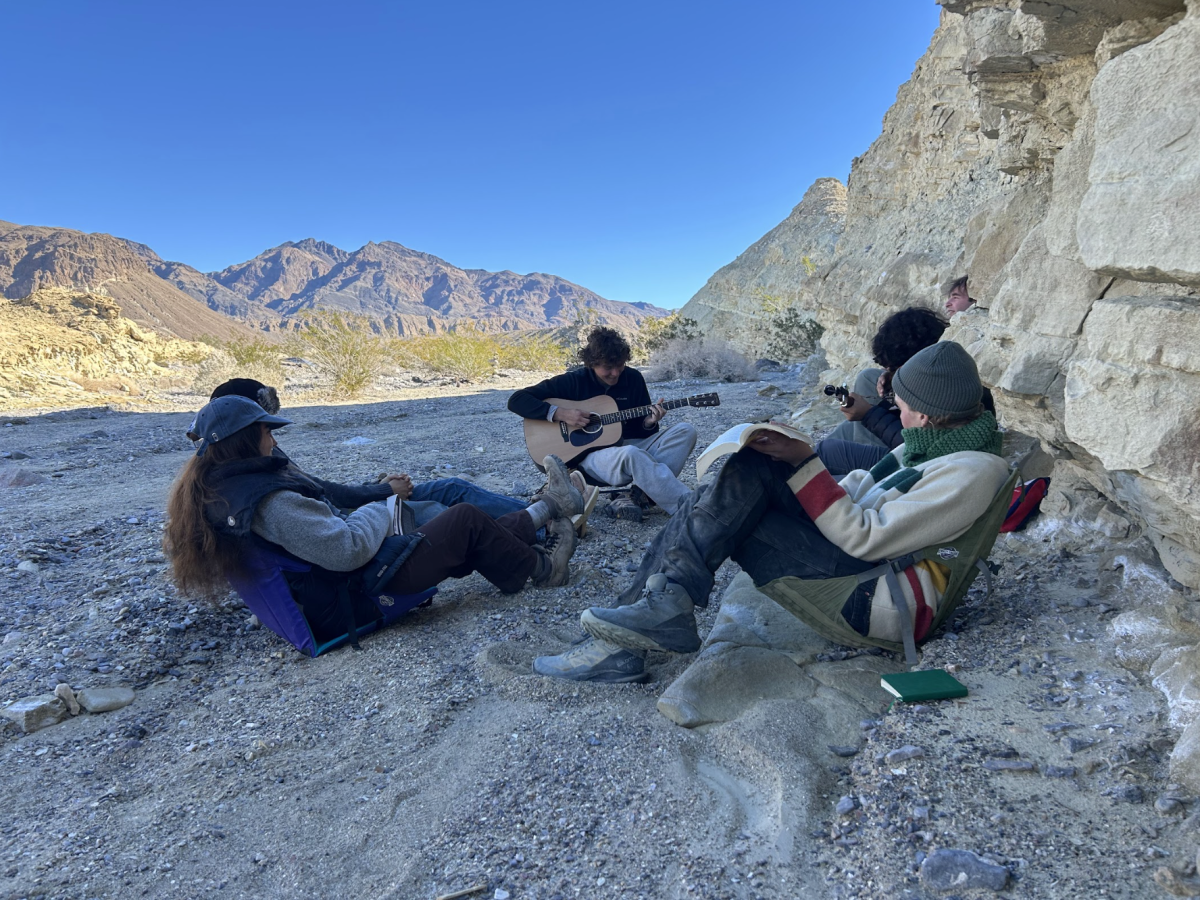
In a world where the lives of high school students rarely slow down, ten days in the desert bring the blur to a sudden halt. Since 2016, Sonoma Academy has offered Wilderness Quest as an Intersession option for upperclassmen. It is advertised as a rite of passage with the intent to help older students say goodbye to youth and connect with their inner strengths to move more mindfully into adulthood.
STEM Teacher and Freshman Dean Amber Greer, who has been a leading force of Wilderness Quest since 2017, is consistently inspired by the students’ transformations. Aside from her duties as a teacher and chaperone, she finds herself annually embracing the healing qualities that she has found in the desert. “I have a chance to be alone if I want to be alone. As a person, a teacher, an adult, there are very few opportunities I actually have to be by myself. If I want to go sit by my tarp, I can sit there for two hours and journal, or I can go for a walk,” Greer said.
For ten days, students have the opportunity to create a self-imposed bridge into adulthood in a way that is unique to each individual. The time is split up into three phases: severance, threshold, and incorporation.
Severance is exactly what it sounds like: when the tie between the students and the outside world is split upon their arrival in the desert. During severance, the students have the opportunity to prepare themselves for the journey ahead with the support of experienced guides.
Kenny Hamann (‘26) began Wilderness Quest just three days after turning 18: “I was freshly an adult, and I didn’t really feel like one, so the ritual of the trip, being newly 18, definitely added to the spectacular experience that the trip was.”
After the students spent three days adjusting to the desert, they moved into the threshold phase. This is the infamous three-day solo period, where students fast and exist only in the company of themselves. This period is meant to create space to ponder the places to which the mind wants to wander.
For Calvin Schaeffer (‘26), the solo wasn’t what he expected. Schaeffer entered Wilderness Quest with the sole focus of completing something really challenging. “I was going to be a monk,” he said, planning to walk for hours and fast mindfully.
Instead, he found himself following where the wind took him: sleeping for the majority of the three days. During the hours that he did spend awake, Schaeffer swapped jokes with himself, traced pictures in the sand, wrote letters to friends back home, sang tracks from Violent Femmes and Elliott Smith and sat alone with silence.
Silence, an atmosphere which many consider to be peaceful, felt far more intense to Schaeffer in the desert: “At home, you listen, and it’s quiet. But out there, you listen, and the only thing you can hear is silence. It feels deafening.”
Though Schaeffer may not have become a monk, Hamann found a deep meditative state during his time alone. On the third day of his solo, he meditated in the same spot for half a day. When he first sat down, the sun was yet to come up, glowing below the horizon. When he opened his eyes again, the sun was high in the sky, and it was midday in the desert.
“I grew up doing karate,” Hamann said. “[The solo] was basically the meditational part of that. It was really fun to finally become a Buddha.”
After the solo, students reunite to begin the last phase: incorporation. According to Greer, incorporation is often the hardest part for students. “The world, school and the family, they’re exactly the same as when you left, but you’re different now,” she said. Returning to a place that is often incohesive with the student’s newfound outlooks on life proves to be very difficult.
Learning how to re-enter the world after experiencing the solo is intense. Schaeffer described the mental strain of incorporation, explaining that, “rather than achieving something, [his classmates] achieved the start of something.”
Hamann confirmed Schaffer’s statement: “It was really, really hard to come back into society because I had such an otherworldly experience out in the desert.”
Continuing to digest and embrace slowness over the next three days was a real test after completing the solo–the part he initially thought was going to be the hardest. For him, the elation from achieving such a milestone and the desire to bring his new wisdom into the world immediately were hard to shake.
As the ten-day quest came to a close, students came back home with a hearty appreciation for simplicity, themselves and each other. Eventually, though, the bubble separating the desert from the real world had to be popped.
“Some people had trouble going back on their phones. I didn’t have trouble. I was so ready to listen to my music,” Hamann admitted.
The true purpose of Wilderness Quest is perhaps something that can never be completely understood. Its power lies in the pursuit of the mundane and the mystery of what it means to be human. Despite it being a uniquely odd experience, Hamann leaves future participants of Wilderness Quest with a simple message:
“It’s the most meaningful thing I’ve ever done. I really mean that.”