



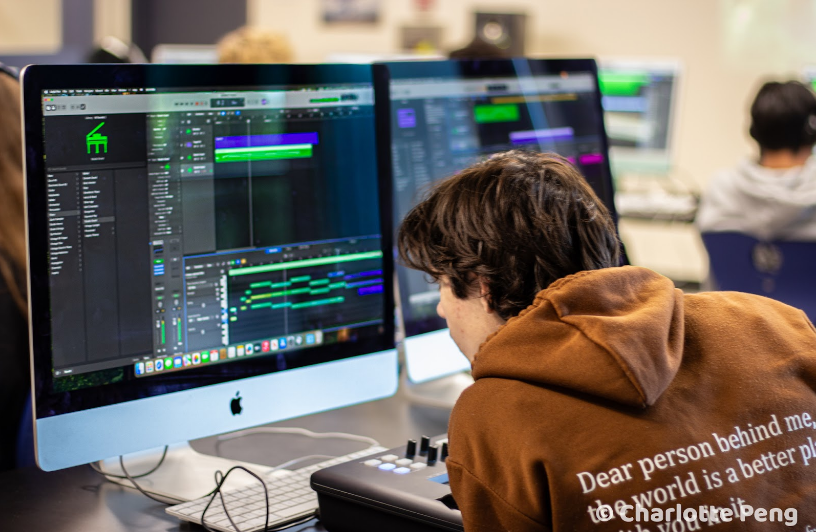
The Music Production and Beat Design Intersession taught students “treble-free” instrumental techniques in the Digital Media Lab. The course described the purpose of music-making: to “develop original musical ideas” and “explore new genres outside [students’] comfort zones.” But what really happened in the far right corner of the Under GAC?
Over this eight-day-long course, students created their own soundtracks and audio recordings using computers and instruments. The course provided a great experience for students, especially for first-time participants in music-making.
For example, Annie Leyba (‘29) said she created music on a new app she had never used before, Apple Logic Pro. According to Leyba, “it was like GarageBand, but way better. It had a lot more things that you can use.”
On Logic Pro, there were numerous tools and accessories to choose from to create a unique piece. The most used were loops, which were sortable by instrument and sound type, and they could be dragged into the musical playground. MIDI keyboards were also provided. They offered not just multiple piano styles but also different instrument sounds. Additionally, there was an option to change the keyboard scale.
In total, 16 students enrolled in the intersession. Leyba stated, “Everyone had a different style,” and it really was true. The songs varied among students, featuring a mix of distinct beats, sounds, genres, and rhythms.
Some songs were acoustic, which included pianos, drums, and bass, while others were more synth-based. Some people even recorded their own vocals with the sound booth. Using Logic Pro’s record feature, students could sing into a microphone or record guitar or drum playing, and the recording could be inserted into the song.
Other students, like Casey Pasdach (‘27), went an entirely different direction and made synth-based music. As Pasdach commented, “I got to make different beats, and synth sounds were cool to make.”
People were also able to experiment throughout the process. Pasdach noted that a few worked together to create harmonies in their songs. For example, she created a song with two others via singing. Each person recorded their own part separately, then lined up the parts so they could play together.
Grant Sanders (‘28), an avid coder and music enthusiast, went above and beyond by composing not one, but ten songs on Logic Pro. “There were only two or three [songs] that I was really proud of,” he said. “The rest were just messing around or learning something.”
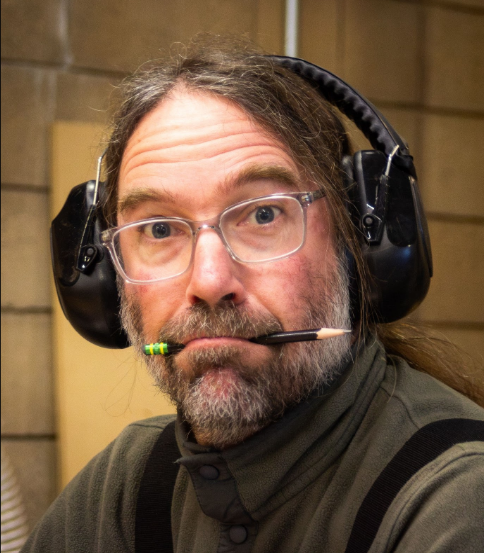
Music teacher Daniel Reiter loved seeing the different genres and styles that students composed. As he put it, “You never know what students will create each time.” His favorite moment of the course was the demo recording session. It showed students the live recording process that they didn’t get from Logic Pro. “All of the tools that you use on Logic Pro used to come from the studio, where it would be live, when there weren’t computers.”
As a younger musician, Reiter himself loved electronic music and wanted to produce similar sounds. He dove into sound engineering and studied music in college, where he learned how to create his own music.
Reiter’s main intention with this course was to share his passion and get some students who had never been involved in music previously to step outside their comfort zone and try new music-making skills.
From learning about different rhythms, sounds, and beats in Logic Pro to learning how to compose a song, Music Production and Beat Design offered pitch-perfect education on the makings of music. And who knows, maybe this class will produce a new musician at SA!